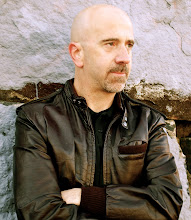
Here's today's burning question: How do writers manage to avoid becoming the most pessimistic people in the world? Given the amount of rejection even the most successful authors experience or at least have experienced in the past, how do they manage to keep a cheery (or at least a sane) view of the world?
Obviously emotional makeup has a lot to do with it. Some people can have the most horrific, earth-shaking tragedies befall them and still wake up with a smile on their faces every day. It's amazing, and more than a little creepy. Then there's me.
My wife says the glass isn't just half empty with me, but that the entire thing is bone-dry, and has been thrown on the floor and smashed into a thousand tiny pieces as well, and that I have stepped on them and now have dozens of glittering, razor-sharp shards embedded in the sole of my foot. Unless I'm missing her point, I'm pretty sure she thinks I'm something less than a full-fledged optimist.
On the other hand, every time I send a short story out to a publication; or I send a query, a partial manuscript, or (wonder of wonders!) a full manuscript out to an agent, I can honestly say I do so believing this is the one that will be accepted with open arms; that the agent or editor will get what I'm trying to say and will be enthusiastically receptive. Sometimes that even happens!
But the success rate isn't exactly high, and so more often than not I find myself stepping on those shards of glass. I'm like Charlie Brown running up to kick the football that Lucy is holding. Every time he runs up to it she pulls it away and he falls flat on his back, but the next time he runs up to it, he does so fully expecting her to leave the ball on the ground so he can kick it.
All of which brings me back to my question: how do writers avoid being the worst kind of foul-tempered, curmudgeonly pessimists? And if I believe when I send material out that it's going to be looked at favorably, doesn't that make me the opposite, and I am in fact a bold-faced optimist? And does it even matter?
These are the sorts of things I think about while trying to motivate myself to research shoulder-fired missiles or begin outlining my new novel. But, still, the fact that I'm procrastinating doesn't make the question any less valid. Does it?
Wednesday, July 30, 2008


Sunday, July 27, 2008
Genre Blues
Spent this morning putting the finishing touches on my latest short story, "Dead and Buried," and trying to decide exactly where would be the best place to submit it. Maybe it's just me, but this genre stuff is confusing, because a lot of what I write can fit comfortably into more than one genre - several, usually - and if you look at it conversely, it doesn't really fit completely into any.
"Dead and Buried" is a perfect example of what I'm talking about. The story was inspired by the cool Nickelback song, "Follow You Home," and if you're not familiar with the song, it tells the story of a dude so obsessed with a girl that he keeps on coming back, no matter what she does to him:
"Well you can stick me in a hole - And you can pray all day for rain - You can shoot me in the leg - Just to try to make me beg - And you can leave me there for days - And I'll stay alive - Just to follow you home."
In my story, the guy getting dumped on is a scorned husband who is killed in the middle of a desolate forest by his wife's lover but isn't quite ready to be dead. I don't want to give away the whole story because I'm hoping it will published somewhere, but it's part mystery, part noir, part horror, part pulp fiction.
So the obvious question is this: What the hell do I do with it? Most magazines are pretty specific about what they want from their contributions. Do I edit it and change it around to try to pigeonhole it into the one particular genre of the magazine to which I eventually choose to submit it?
Answer: No, I most certainly do not. I've tried cutting and slashing (no pun intended, I swear) a story to make it fit either length or genre format and it never seems to work. So I'm going to bite the bullet (again, no pun intended; sorry, I just can't seem to help it) and pick the most likely candidate and submit. And pray.
That's not to say I don't edit my work - I edit and rewrite and edit and rewrite so many times I sometimes feel like I'm using all that busy work as an excuse not to risk rejection by doing anything else with the material. But I can't see editing and drastically changing a story once I feel it's ready, just to suit a magazine that may come back and tell me it's not right for them anyway. Does that make sense?
In any event, there's a noir fiction ezine called Backalley that I'm leaning toward right now for "Dead and Buried," but don't quote me on that. I reserve the right to change my mind in the next day or two before I do the actual submitting. Maybe I'll just turn the whole thing into a lighthearted romp and submit it to Reader's Digest. Just kidding.
Here goes nothing.
"Dead and Buried" is a perfect example of what I'm talking about. The story was inspired by the cool Nickelback song, "Follow You Home," and if you're not familiar with the song, it tells the story of a dude so obsessed with a girl that he keeps on coming back, no matter what she does to him:
"Well you can stick me in a hole - And you can pray all day for rain - You can shoot me in the leg - Just to try to make me beg - And you can leave me there for days - And I'll stay alive - Just to follow you home."
In my story, the guy getting dumped on is a scorned husband who is killed in the middle of a desolate forest by his wife's lover but isn't quite ready to be dead. I don't want to give away the whole story because I'm hoping it will published somewhere, but it's part mystery, part noir, part horror, part pulp fiction.
So the obvious question is this: What the hell do I do with it? Most magazines are pretty specific about what they want from their contributions. Do I edit it and change it around to try to pigeonhole it into the one particular genre of the magazine to which I eventually choose to submit it?
Answer: No, I most certainly do not. I've tried cutting and slashing (no pun intended, I swear) a story to make it fit either length or genre format and it never seems to work. So I'm going to bite the bullet (again, no pun intended; sorry, I just can't seem to help it) and pick the most likely candidate and submit. And pray.
That's not to say I don't edit my work - I edit and rewrite and edit and rewrite so many times I sometimes feel like I'm using all that busy work as an excuse not to risk rejection by doing anything else with the material. But I can't see editing and drastically changing a story once I feel it's ready, just to suit a magazine that may come back and tell me it's not right for them anyway. Does that make sense?
In any event, there's a noir fiction ezine called Backalley that I'm leaning toward right now for "Dead and Buried," but don't quote me on that. I reserve the right to change my mind in the next day or two before I do the actual submitting. Maybe I'll just turn the whole thing into a lighthearted romp and submit it to Reader's Digest. Just kidding.
Here goes nothing.
Thursday, July 24, 2008
Why Couldn't I Have Been Hired at the CIA?
A lot of what went on during the three hours of Agentfest is a blur to me. The time was spent:
1) Rehearsing the pitch I wanted to give to the next agent in line, so I could be relatively certain my mind wasn't going to go blank on me at the most inopportune time (fortunately that only happened once or twice - I'm sure those agents didn't even notice),
2) Making the most of the three excruciatingly difficult minutes I was allotted in front of as many agents as possible,
3) Writing quick notes about the reaction of each agent and what materials (if any) they had requested at the end of my three minutes, and
4) Getting in line behind another agent, preparing to start the whole process over again.
It was a little like what I imagine those Ameican Idol auditions are like, where the nervous singer stands in front of Randy, Paula and Simon and sings his little heart out. Only instead of doing it once, for three minutes, you had to do it over, and over, and over, for three hours. So, to say I was stressed is a collossal understatement.
But there is one thing I remember very clearly. One agent asked me what I did for work, and when I told him I was an air traffic controller, he asked why I didn't write a thriller about ATC. The question was a little disappointing to hear, since it was a sign even Stevie Wonder could read that he wasn't interested in the novel I actually had written, but it's still a pretty good question.
It seems like it would be a natural, right? Agents and publishers love to see fiction written by authorities, which is why you see so many ex-cops write books about cops and so many ex-spies write spy novels, etc. Makes sense I suppose - who can bring greater realism to a story than someone who has actually done the job?
The problem is, I've been a controller for more than 26 years; it's all I've done my entire adult life, and I'm tired of it. I want to write about things that are much more interesting to me, although I'm fully aware that a great many people find the work I do to be fascinating.
So, although I haven't started my next novel yet - I'm still kicking ideas around in what passes for my brain - I may very well bite the bullet and write the definitive air traffic control thriller. It could be kind of fun and if it would allow me to get a foot in the door with an agent or a publisher, since I'd be the all-important authority, it might not be a bad move to make.
Wow, me an authority on something. Who would have guessed?
1) Rehearsing the pitch I wanted to give to the next agent in line, so I could be relatively certain my mind wasn't going to go blank on me at the most inopportune time (fortunately that only happened once or twice - I'm sure those agents didn't even notice),
2) Making the most of the three excruciatingly difficult minutes I was allotted in front of as many agents as possible,
3) Writing quick notes about the reaction of each agent and what materials (if any) they had requested at the end of my three minutes, and
4) Getting in line behind another agent, preparing to start the whole process over again.
It was a little like what I imagine those Ameican Idol auditions are like, where the nervous singer stands in front of Randy, Paula and Simon and sings his little heart out. Only instead of doing it once, for three minutes, you had to do it over, and over, and over, for three hours. So, to say I was stressed is a collossal understatement.
But there is one thing I remember very clearly. One agent asked me what I did for work, and when I told him I was an air traffic controller, he asked why I didn't write a thriller about ATC. The question was a little disappointing to hear, since it was a sign even Stevie Wonder could read that he wasn't interested in the novel I actually had written, but it's still a pretty good question.
It seems like it would be a natural, right? Agents and publishers love to see fiction written by authorities, which is why you see so many ex-cops write books about cops and so many ex-spies write spy novels, etc. Makes sense I suppose - who can bring greater realism to a story than someone who has actually done the job?
The problem is, I've been a controller for more than 26 years; it's all I've done my entire adult life, and I'm tired of it. I want to write about things that are much more interesting to me, although I'm fully aware that a great many people find the work I do to be fascinating.
So, although I haven't started my next novel yet - I'm still kicking ideas around in what passes for my brain - I may very well bite the bullet and write the definitive air traffic control thriller. It could be kind of fun and if it would allow me to get a foot in the door with an agent or a publisher, since I'd be the all-important authority, it might not be a bad move to make.
Wow, me an authority on something. Who would have guessed?
I'll Get Right Back To You - Or Not
Different literary agencies seem to have very different policies about dealing with submissions, at least from unknown guys like me with none of the all-important "connections."
I don't know Lawrence Block, I'm not related to Lisa Gardner, I didn't go to college with Barry Eisler (although I attended a panel discussion he did, and I'm pretty sure he would have been a fun guy to have as a roommate), so in the hierarchy of significance to literary agents I fall somewhere between the guy that shampoos the office carpets at the agency and the dude that parks their Hummers when they go to work.
One thing I've discovered is it's really important to do your homework before querying agents, because some like to open real, live mail, the kind that trees give their lives for every day, while others feel very strongly that email is the way to go. Likewise, some agencies specify right on their websites that they will only respond to queries that they are interested in, and the rest of us can pound sand. They don't phrase it quite that way, but you get the idea.
Some agencies I queried way back in March have never gotten back to me yet, which leads me to believe they might be a little ambivalent about my letter. Others were so anxious to brush me off that they waited all of two or three hours to tell me they weren't interested.
But I understand that agents get bombarded with queries every day and don't have a lot of time to spend sorting through them. On the other hand, if an agent requests material, don't you think it would only be right to give the author (that would be me) some sort of heads up as to what's going on after a couple of months?
Something really simple would be okay: "Dear Allan, we are busy busting our butts for our real clients, getting them on to the bestseller lists, so we haven't had time to review your outstanding submission yet. We'll get to it soon though, we promise. Just as soon as the carpet guy gets done shampooing our office floor. Thanks for your patience, A1 Literary Agency."
That would be okay, just a sentence or two to let me know they actually still want to read it. After all, they were the ones who asked for it, right? And I did send it out way back in March, right?
On the other hand, if I haven't heard anything, I can still tell myself that maybe they love it! So forget I said anything. It's all good.
I don't know Lawrence Block, I'm not related to Lisa Gardner, I didn't go to college with Barry Eisler (although I attended a panel discussion he did, and I'm pretty sure he would have been a fun guy to have as a roommate), so in the hierarchy of significance to literary agents I fall somewhere between the guy that shampoos the office carpets at the agency and the dude that parks their Hummers when they go to work.
One thing I've discovered is it's really important to do your homework before querying agents, because some like to open real, live mail, the kind that trees give their lives for every day, while others feel very strongly that email is the way to go. Likewise, some agencies specify right on their websites that they will only respond to queries that they are interested in, and the rest of us can pound sand. They don't phrase it quite that way, but you get the idea.
Some agencies I queried way back in March have never gotten back to me yet, which leads me to believe they might be a little ambivalent about my letter. Others were so anxious to brush me off that they waited all of two or three hours to tell me they weren't interested.
But I understand that agents get bombarded with queries every day and don't have a lot of time to spend sorting through them. On the other hand, if an agent requests material, don't you think it would only be right to give the author (that would be me) some sort of heads up as to what's going on after a couple of months?
Something really simple would be okay: "Dear Allan, we are busy busting our butts for our real clients, getting them on to the bestseller lists, so we haven't had time to review your outstanding submission yet. We'll get to it soon though, we promise. Just as soon as the carpet guy gets done shampooing our office floor. Thanks for your patience, A1 Literary Agency."
That would be okay, just a sentence or two to let me know they actually still want to read it. After all, they were the ones who asked for it, right? And I did send it out way back in March, right?
On the other hand, if I haven't heard anything, I can still tell myself that maybe they love it! So forget I said anything. It's all good.
Tuesday, July 22, 2008
Having A Really Grand Time
Let's talk money for a moment, shall we? If you've read my previous posts you know that I spent two days in Manhattan, July 9 and 10, for Thrillerfest 2008. I attended panel discussions on various writing topics by many different heavy-hitters in the thriller genre, and spent three nerve-wracking hours on the afternoon of the tenth pitching my novel to literary agents.
The event was held in the swank Grand Hyatt - I know it's swank because after I got home my credit card company called suspecting my card had been stolen. Even they know I would never normally stay in a place that fancy.
Luckily, I was able to get the special Thrillerfest rate for the one night I spent wrapped in the comforts of luxury, otherwise it would have been even more than the three hundred bucks a night they were able to charge, impressively managing to keep a straight face while quoting the rate.
But that's not all! In addition to the nightly rate (I exaggerated, it was really only $299 a night, not $300), there were various and sundry city and state taxes attached to the charge. I very strongly suspect that I have now contributed to the one billion dollar construction of the new Yankee Stadium which, if true, frosts me more than anything else since I'm a die-hard Red Sox fan.
I finally got into my room around 9:00 p.m. Wednesday night, exhausted from being on the go all day and starving, since I literally had not eaten since the night before. I ordered a pizza (roughly the size of a medium, if you can picture that), as well as apple pie and ice cream for dessert. No drink. Care to take a guess how much that cost me? Including tip, it came to $52 bucks!
It's a good thing Babe Ruth isn't alive. He'd go broke inside of about three weeks gorging himself on beer and hot dogs if he played for the Yankees in this day and age.
The final assault on my wallet was staged Thursday. Due to the format of the program I was attending, I would not have another chance to check out until the end of the day, so I checked out of my room at 7:30 in the morning to avoid having to pay for a second day and possibly contributing to a George Steinbrenner statue or something.
When I checked out, the hotel graciously offered to hold my bags until my departure that evening, for the low price of two dollars a bag! Are you kidding me? Three large a night and they can't hold my bags for me for a few hours?
The grand total, for one night staying in Manhattan, came to over four hundred dollars, and that doesn't include what it cost to attend Thrillerfest - that was just the hotel charge. If the whole adventure results in me snagging an agent, it will have been a small price to pay, but still, the frugal Yankee in me is having a really hard time dealing with this legalized mugging.
Oh yeah, I almost forgot this nugget: I drove to Bridgeport, Connecticut and took the train into Manhattan, because the Hyatt was going to charge me two hundred bucks to park my truck! Now I know why it's called the "Grand" Hyatt - If you're not careful, it will cost you a grand a night to stay there!
The event was held in the swank Grand Hyatt - I know it's swank because after I got home my credit card company called suspecting my card had been stolen. Even they know I would never normally stay in a place that fancy.
Luckily, I was able to get the special Thrillerfest rate for the one night I spent wrapped in the comforts of luxury, otherwise it would have been even more than the three hundred bucks a night they were able to charge, impressively managing to keep a straight face while quoting the rate.
But that's not all! In addition to the nightly rate (I exaggerated, it was really only $299 a night, not $300), there were various and sundry city and state taxes attached to the charge. I very strongly suspect that I have now contributed to the one billion dollar construction of the new Yankee Stadium which, if true, frosts me more than anything else since I'm a die-hard Red Sox fan.
I finally got into my room around 9:00 p.m. Wednesday night, exhausted from being on the go all day and starving, since I literally had not eaten since the night before. I ordered a pizza (roughly the size of a medium, if you can picture that), as well as apple pie and ice cream for dessert. No drink. Care to take a guess how much that cost me? Including tip, it came to $52 bucks!
It's a good thing Babe Ruth isn't alive. He'd go broke inside of about three weeks gorging himself on beer and hot dogs if he played for the Yankees in this day and age.
The final assault on my wallet was staged Thursday. Due to the format of the program I was attending, I would not have another chance to check out until the end of the day, so I checked out of my room at 7:30 in the morning to avoid having to pay for a second day and possibly contributing to a George Steinbrenner statue or something.
When I checked out, the hotel graciously offered to hold my bags until my departure that evening, for the low price of two dollars a bag! Are you kidding me? Three large a night and they can't hold my bags for me for a few hours?
The grand total, for one night staying in Manhattan, came to over four hundred dollars, and that doesn't include what it cost to attend Thrillerfest - that was just the hotel charge. If the whole adventure results in me snagging an agent, it will have been a small price to pay, but still, the frugal Yankee in me is having a really hard time dealing with this legalized mugging.
Oh yeah, I almost forgot this nugget: I drove to Bridgeport, Connecticut and took the train into Manhattan, because the Hyatt was going to charge me two hundred bucks to park my truck! Now I know why it's called the "Grand" Hyatt - If you're not careful, it will cost you a grand a night to stay there!
Monday, July 21, 2008
The Beatings Will Continue Until Morale Improves
Got rejected today. Not a big deal in the grand scheme of things, really. Anyone trying to write who hasn't experienced their fair share of rejection is, well, probably Ayn Rand or someone like that. And yes, I know Ayn Rand is dead, which I suppose you could classify as the ultimate rejection, but you get my point - writers get rejected all the time.
In his wonderful book, On Writing, Stephen King talks about how he literally papered his wall with rejections when he was starting out. He would impale each one (This was back in the days when you got a real piece of paper to hold in your hands when you got rejected - you could tear it up, toss it in the trash, use it to wipe your...well, you get the point) on a spike driven into his bedroom wall, and eventually the pile got so big he had to start a new one, with a new spike.
Now, unfortunately, most of the rejecting is going on electronically, so you don't get the pleasure of crumpling up the offending sheet of paper and flushing it down the toilet, or setting it on fire, or whatever. You could print it out and then do that stuff to it, but somehow it just doesn't seem like it would be the same.
Anyway, Stephen King was a teenager when he was doing his rejection-paper-slaughtering, but it's still instructive; I believe we can learn two things from this example:
1) Stephen King was always a little...different...even when he was a youngster, and,
2) Even the most successful of modern-day writers have to suffer through rejection, which supposedly builds character, but seems to me only serves to make you miserable.
Here's my point, though, and if you're still reading, congratulations and thanks for staying with me, mom. The rejection I received today was from the agent I had counted as my Number One Possibility from Agentfest. She had requested the first 100 pages of my manuscript after the Agentfest chaos and had contacted me within hours after receiving it, asking for the full manuscript. She was extremely complimentary and very encouraging.
Now this.
Anyway, I got curious as to exactly how many rejections I've received from agents as well as magazines, and the total is...drumroll please...wait for it...today makes an even fifty! Now, this isn't all for the same material, you understand, it includes short story rejections, novel manuscript rejections, blah, blah, blah.
But it all adds up to the same thing - fifty times people have said, "Hey, you, you're not good enough." We're not supposed to take it personally, and I get that, I really do.
But sometimes it's really hard not to.
In his wonderful book, On Writing, Stephen King talks about how he literally papered his wall with rejections when he was starting out. He would impale each one (This was back in the days when you got a real piece of paper to hold in your hands when you got rejected - you could tear it up, toss it in the trash, use it to wipe your...well, you get the point) on a spike driven into his bedroom wall, and eventually the pile got so big he had to start a new one, with a new spike.
Now, unfortunately, most of the rejecting is going on electronically, so you don't get the pleasure of crumpling up the offending sheet of paper and flushing it down the toilet, or setting it on fire, or whatever. You could print it out and then do that stuff to it, but somehow it just doesn't seem like it would be the same.
Anyway, Stephen King was a teenager when he was doing his rejection-paper-slaughtering, but it's still instructive; I believe we can learn two things from this example:
1) Stephen King was always a little...different...even when he was a youngster, and,
2) Even the most successful of modern-day writers have to suffer through rejection, which supposedly builds character, but seems to me only serves to make you miserable.
Here's my point, though, and if you're still reading, congratulations and thanks for staying with me, mom. The rejection I received today was from the agent I had counted as my Number One Possibility from Agentfest. She had requested the first 100 pages of my manuscript after the Agentfest chaos and had contacted me within hours after receiving it, asking for the full manuscript. She was extremely complimentary and very encouraging.
Now this.
Anyway, I got curious as to exactly how many rejections I've received from agents as well as magazines, and the total is...drumroll please...wait for it...today makes an even fifty! Now, this isn't all for the same material, you understand, it includes short story rejections, novel manuscript rejections, blah, blah, blah.
But it all adds up to the same thing - fifty times people have said, "Hey, you, you're not good enough." We're not supposed to take it personally, and I get that, I really do.
But sometimes it's really hard not to.
Sunday, July 20, 2008
Don't You Know Who I Am?
So there I am, standing in the mezzanine on the second floor of the Grand Hyatt Hotel in New York, attending a reception for authors and agents after the first day of Thrillerfest 2008, the big, five-day event featuring some of the biggest names in the thriller-writing genre, plus me.
That reminds me, I still haven't figured out why it's called the "Grand" Hyatt. I assumed it got its name because of the fact that it's located about fifty feet from Grand Central Station - so close, in fact, that even I managed to find it after stepping off the train, and I've only been to New York one other time. I'm such a bumpkin that I'm the guy New Yorkers picture when they think of out-of-town visitors being overwhelmed by their city.
But the thing is, the hotel could have been named the "Grand" Hyatt due to the fact that the inside of it looks like the kind of place my mother would have forbidden me to touch anything in when I was a kid, for fear that I would have broken something and we wouldn't have had the money to pay for it. I mean, this place was fancy, featuring a waterfall inside the lobby!
But I digress. So I was standing in the middle of this reception, feeling like a sixth-grade kid at his first junior high dance, afraid to talk to any of the girls, when Donald Maass wanders by and starts talking to me and another aspiring author, Greg Burton, who had seen how lost I looked and taken pity on me.
Now, if you're not involved in writing or publishing, you probably have never heard of Donald Maass. I hadn't, until I got it in my head that I could be a writer. But he's the owner and official Big Cheese of the Donald Maass Literary Agency, one of the oldest and most prestigous in the city, at least out of the agencies that will deal with plebeians like me. He's Stuart Kaminsky' agent, if that means anything to you.
Now I find myself, ten minutes after feeling like the last kid picked for the kickball game at recess, talking one-on-one with Donald Maass, after Greg got pulled away by another group!
Want to hear something funny? Donald Maass is a regular guy! He was friendly and pleasant and spent about fifteen minutes just chatting with me, until a pushy young lady elbowed her way past me and took Donald Maass for herself.
But that's okay, because before he was kidnapped, metaphorically speaking, Donald Maass inquired about my project and listened with interest (at least he seemed to be interested, but maybe he's just really good at hiding his boredom) as I explained my book to him. He gave me his card, the one with his personal email address on it, and invited me to send him my material.
So now, Donald Maass himself is reviewing my manuscript. Or perhaps he handed it to his newest assistant after it came in - who knows? - but I have at the moment at least the possibility of gaining representation by the Donald Maass Literary Agency. Stranger things have happened, although I really can't think of any offhand.
At least he didn't give me the finger and send me on my way, which was usually what happened at those junior-high dances when I finally got up the nerve to ask the girl to dance...
That reminds me, I still haven't figured out why it's called the "Grand" Hyatt. I assumed it got its name because of the fact that it's located about fifty feet from Grand Central Station - so close, in fact, that even I managed to find it after stepping off the train, and I've only been to New York one other time. I'm such a bumpkin that I'm the guy New Yorkers picture when they think of out-of-town visitors being overwhelmed by their city.
But the thing is, the hotel could have been named the "Grand" Hyatt due to the fact that the inside of it looks like the kind of place my mother would have forbidden me to touch anything in when I was a kid, for fear that I would have broken something and we wouldn't have had the money to pay for it. I mean, this place was fancy, featuring a waterfall inside the lobby!
But I digress. So I was standing in the middle of this reception, feeling like a sixth-grade kid at his first junior high dance, afraid to talk to any of the girls, when Donald Maass wanders by and starts talking to me and another aspiring author, Greg Burton, who had seen how lost I looked and taken pity on me.
Now, if you're not involved in writing or publishing, you probably have never heard of Donald Maass. I hadn't, until I got it in my head that I could be a writer. But he's the owner and official Big Cheese of the Donald Maass Literary Agency, one of the oldest and most prestigous in the city, at least out of the agencies that will deal with plebeians like me. He's Stuart Kaminsky' agent, if that means anything to you.
Now I find myself, ten minutes after feeling like the last kid picked for the kickball game at recess, talking one-on-one with Donald Maass, after Greg got pulled away by another group!
Want to hear something funny? Donald Maass is a regular guy! He was friendly and pleasant and spent about fifteen minutes just chatting with me, until a pushy young lady elbowed her way past me and took Donald Maass for herself.
But that's okay, because before he was kidnapped, metaphorically speaking, Donald Maass inquired about my project and listened with interest (at least he seemed to be interested, but maybe he's just really good at hiding his boredom) as I explained my book to him. He gave me his card, the one with his personal email address on it, and invited me to send him my material.
So now, Donald Maass himself is reviewing my manuscript. Or perhaps he handed it to his newest assistant after it came in - who knows? - but I have at the moment at least the possibility of gaining representation by the Donald Maass Literary Agency. Stranger things have happened, although I really can't think of any offhand.
At least he didn't give me the finger and send me on my way, which was usually what happened at those junior-high dances when I finally got up the nerve to ask the girl to dance...
Subscribe to:
Posts (Atom)